

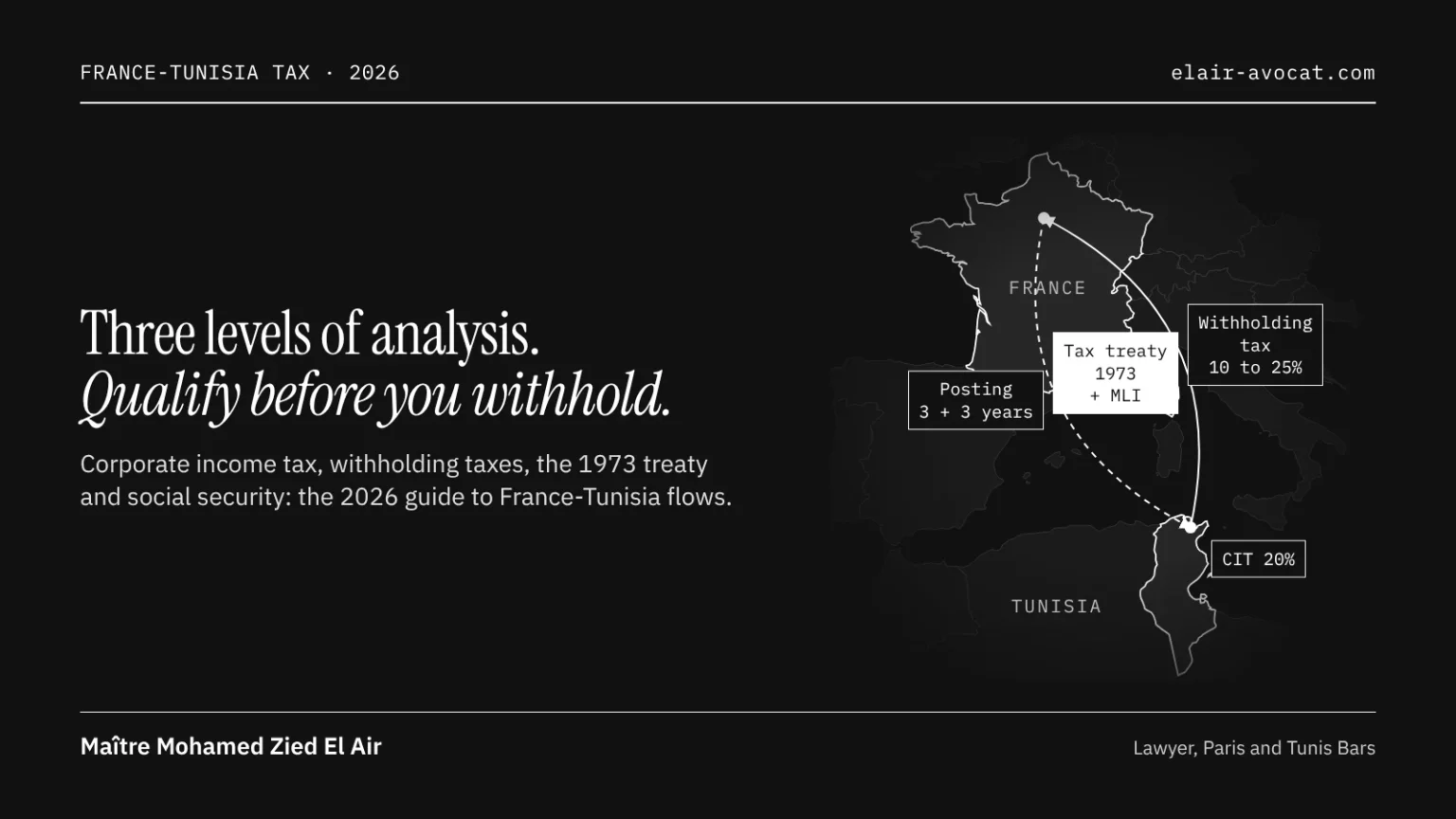
In 2026, any transaction between France and Tunisia still has to be analysed at three levels: Tunisian domestic tax law (corporate income tax at 20%, withholding taxes of 10% to 25%), the France-Tunisia tax treaty of 28 May 1973, amended since 2024 by the OECD Multilateral Instrument (MLI), and the social security rules arising from the France-Tunisia agreement of 26 June 2003. “Exporting” or “offshore” status is no longer enough to determine the tax due. This guide sets out the rules that actually apply to exporting companies, non-residents and expatriate or posted employees, updated for the Tunisian Finance Laws for 2025 and 2026.
Key points (as at 1 November 2026)
- 20%: standard corporate income tax (CIT) rate in Tunisia since the Finance Law for 2025, up from 15%. Rates of 10%, 35% and 40% apply to exhaustively listed activities.
- No automatic reduced CIT rate for exports since the transitional regime ended on 31 December 2020.
- 15%: domestic withholding tax on fees paid to a non-resident without a permanent establishment (25% for a beneficiary located in a preferential tax regime).
- 10%: final withholding tax on dividends; the France-Tunisia treaty does not reduce it.
- 12%: treaty cap on Tunisian withholding tax on interest paid to a French resident.
- 20%: final withholding tax on the salaries of non-residents working in Tunisia for six months or less in the year, subject to the treaty.
- 183 days: threshold for Tunisian tax residence and criterion under Article 22 of the treaty for employees.
- 3 years + 3 years: maximum length of a social security posting from France to Tunisia (initial posting, then extension).
- 100%: VAT withheld by the Tunisian client on services supplied by a non-resident without a permanent establishment.
Contents
- Who this guide is for
- What changes in 2026
- Concepts to qualify before any analysis
- The France-Tunisia tax treaty and the MLI
- Exporting companies in Tunisia: the tax that actually applies
- Expatriate, posted and non-resident employees
- Withholding taxes on payments to non-residents
- Social security: CNSS and France-Tunisia postings
- An eight-step method
- Common mistakes
- Frequently asked questions
1. Who this guide is for
This guide is intended in particular for:
- French and European companies that set up, finance or acquire a subsidiary in Tunisia;
- Tunisian companies that export goods or provide services to foreign clients;
- non-resident directors, consultants, investors and service providers receiving Tunisian-source income;
- employers that recruit, post or expatriate employees between France and Tunisia;
- groups that charge intra-group services, royalties, interest or management fees between the two countries;
- French companies that pay a service provider established in Tunisia.
2. What changes in 2026: the measures of the Tunisian Finance Law
Law No. 2025-17 of 12 December 2025, the Finance Law for 2026, introduced among others the following measures relevant to France-Tunisia transactions:
| Measure | Content | Who is affected |
|---|---|---|
| Permanent 4% contribution | 4% of taxable profit, minimum TND 10,000, not deductible, from profits declared in 2026 | Banks, financial institutions, insurance and reinsurance companies, telecommunications operators, car dealers |
| Social solidarity contribution (CSS) | Exceptional rates extended for 2026: 3% for companies subject to CIT at 20%, 4% for those subject to 35% or 40%; 0.5% for individuals taxed under the progressive scale | All companies and taxpayers under the personal income tax scale |
| Reformed wealth tax | Base extended to movable assets, progressive scale of 0.5% and 1%, assets located in Tunisia and, for tax residents, abroad | Individuals with substantial assets, including expatriates who become resident |
| E-invoicing | Obligation extended to services, technical arrangements left to implementing texts | Service providers established in Tunisia |
| Repatriation of export proceeds | CX5 form abolished, evidence now based on bank documents | Exporters |
| Foreign currency accounts | May be opened without prior authorisation from the Central Bank by resident individuals of Tunisian nationality | Tunisian residents |
| Employment of graduates | The State covers the employer’s CNSS contribution, on a sliding scale over five years (100%, 80%, 60%, 40%, 20%), for recruitments from 1 January 2026 | Private companies recruiting university graduates |
Note: the reform of the Foreign Exchange Code has not yet been adopted. Exchange control is still governed by the 1976 law, and a bill for a new Foreign Exchange Code (No. 115/2025) is under examination by the Assembly of the Representatives of the People.
3. Concepts to qualify before any tax analysis in Tunisia
Tax residence of an individual
Under Article 2 of the Personal Income Tax and Corporate Income Tax Code (IRPP-IS Code), an individual is habitually resident in Tunisia if he or she has a main home there or, failing that, stays there for at least 183 days in the calendar year. A resident is taxable on worldwide income. A non-resident remains taxable in Tunisia on Tunisian-source income.
In the event of dual France-Tunisia residence, Article 3 of the treaty settles the matter successively by reference to the permanent home, the centre of vital interests, the habitual abode and then nationality.
Residence for exchange control purposes
Exchange control residence is distinct from tax residence. A fully exporting company incorporated under Tunisian law may be treated as non-resident for exchange control purposes where at least 66% of its capital is held by non-residents and subscribed through an import of foreign currency. This status makes capital movements easier, but it settles neither corporate income tax nor VAT.
Permanent establishment
For a foreign company, the central question is whether it has a permanent establishment in Tunisia. Article 4 of the treaty defines it as a fixed place of business through which the enterprise carries on all or part of its business: place of management, branch, office, factory, workshop, building or assembly site lasting more than six months, or assembly and supervision operations following the sale of equipment where they last more than three months and their cost exceeds 10% of the price of the equipment.
Since the MLI took effect, the concept has widened: an agent who habitually plays the principal role in concluding contracts may constitute a permanent establishment, and preparatory or auxiliary activities are no longer excluded where they are artificially fragmented between closely related enterprises.
4. The France-Tunisia tax treaty of 28 May 1973, as amended by the MLI
An old text, now supplemented by anti-abuse rules
The France-Tunisia tax treaty, signed in Tunis on 28 May 1973, entered into force on 1 April 1975. It is amended by the Multilateral Convention to Implement Tax Treaty Related Measures (MLI), which entered into force for Tunisia on 1 November 2023. Its effects apply:
- to withholding taxes where the taxable event occurs on or after 1 January 2024;
- to other taxes levied for tax periods beginning on or after 1 May 2024.
The MLI introduces a general anti-abuse clause (principal purpose test): a treaty benefit is denied if it is reasonable to conclude that obtaining it was one of the principal purposes of an arrangement or transaction. It also sets a three-year time limit, from the first notification of the action complained of, for applying to the competent authorities under the mutual agreement procedure.
Allocation of taxing rights: summary table
| Income | Treaty article | Taxation in Tunisia (source State) | Point to watch |
|---|---|---|---|
| Business profits | Art. 11 | Only where there is a permanent establishment in Tunisia | Article 11(7) preserves source taxation of royalties, technical fees and interest provided for by other articles |
| Dividends | Art. 14 | Under Tunisian law, with no treaty cap (10% under domestic law) | Tax credit in France calculated under the protocol |
| Interest | Art. 18 | 12% maximum | Loans granted by a State are exempt at source |
| Copyright (excluding films) | Art. 19(2)(a) | 5% maximum | |
| Patents, designs and models, plans, secret formulas or processes | Art. 19(2)(b) | 15% maximum | In France, tax credit of 20% of the gross amount |
| Information concerning industrial, commercial or scientific experience, technical or economic studies | Art. 19(2)(c) | 15% maximum | Key point for consulting and engineering services |
| Trademarks, films, equipment rental | Art. 19(2)(d) | 20% maximum | The more favourable domestic rate of 15% applies |
| Gains on immovable property and on shares in property-rich companies | Art. 20 and Art. 9 of the MLI | Tunisia, if the property is located there | Property-rich status assessed over the 365 days preceding the disposal |
| Independent personal services | Art. 21 | If there is a fixed base in Tunisia or a stay of at least 183 days in the tax year | |
| Salaries | Art. 22 | If the employment is exercised in Tunisia, unless three cumulative conditions are met | See section 6 |
| Directors’ fees | Art. 23 | Tunisia, if the company is resident in Tunisia | |
| Private pensions | Art. 25 | State of residence of the beneficiary only | Public remuneration falls under Article 26 |
Two French court decisions shed light on how the treaty applies:
- Residence of fully exporting companies. France’s Conseil d’État held that a company incorporated under Tunisian law, exempt only on its export profits but subject to CIT on any activity carried out in Tunisia, is resident in Tunisia within the meaning of Article 3 of the treaty. Amounts paid by a French company for its services therefore fell under Article 11, which led to the discharge of the French withholding tax under Article 182 B of the French Tax Code (CE, 2 February 2022, No. 443018).
- Tax credit on patent royalties. The flat-rate 20% credit provided for by Article 29(1)(d) of the treaty is granted only if the royalties have actually borne tax in Tunisia (CE, 19 February 2024, No. 469407).
The treaty does not cover wealth tax: it covers taxes on income, inheritance taxes, and registration and stamp duties.
5. Exporting companies in Tunisia: the tax that actually applies in 2026
Corporate income tax rates in 2026
Law No. 2024-48 of 9 December 2024, the Finance Law for 2025, raised the standard rate from 15% to 20% for profits made from 1 January 2024.
| Rate | Main activities concerned (Article 49 of the IRPP-IS Code) |
|---|---|
| 10% | Handicrafts, agriculture and fishing, certain cooperatives, support activities and pollution control, companies in regional development zones after the full deduction period |
| 20% | Standard rate, applicable to all activities not covered by another rate, including exporting activities |
| 35% | Payment institutions, SICAF and SICAR investment companies, debt collection companies, telecommunications operators, hydrocarbons sector and oil services, refining and wholesale distribution of petroleum products, large retailers, car dealers, franchisees of foreign brands (unless the integration rate is at least 30%) |
| 40% | Banks, financial institutions (including non-resident ones), insurance and reinsurance companies |
In addition to CIT:
- the social solidarity contribution: 3% of taxable profit for companies taxed at 20% in 2026, giving an overall burden of around 23% for a company under the standard regime, before tax incentives;
- the minimum tax: 0.2% of local turnover including VAT (0.1% for companies taxed at 10%), due where the CIT calculated is lower or in the event of a loss;
- the permanent 4% contribution for the regulated sectors covered by the Finance Law for 2026;
- for the record, the 2% cyclical contribution introduced by the Finance Law for 2025, due once only in 2025 by companies with turnover of at least TND 20 million in 2023.
Exporting no longer gives a reduced rate in itself
The export profit deduction regime, and the transitional rate that replaced it, ended on 31 December 2020. Since 2021, the profits of an exporting company have been taxed at the standard rate, which has been 20% since the Finance Law for 2025. Presenting exports as giving entitlement to an exemption, or to a rate of 10% or 15%, is therefore incorrect in 2026.
The 10% rate remains reserved for profits from the main activity of the categories exhaustively listed in Article 49 of the IRPP-IS Code. An exporting company must check its actual activity, allocate its results and isolate its ancillary income.
The fully exporting company: what remains
The IRPP-IS Code, as worded following Law No. 2017-8 of 14 February 2017 overhauling tax incentives, defines a fully exporting company as one whose goods or services are, in principle, intended entirely for abroad. This status retains real value, but outside corporate income tax:
- sales on the local market allowed up to 30% of the previous year’s export turnover, a ceiling that successive Finance Laws have temporarily raised to 50%; these sales bear the duties and taxes applicable to the local market;
- favourable customs regime for imported inputs;
- specific exchange control regime, with non-resident status where the condition of 66% foreign capital financed in foreign currency is met;
- employer CNSS contribution of 16.57% (compared with 17.07% under the general regime), excluding workplace accidents;
- option for flat-rate taxation at 20% of gross salary for certain executives and trainers of foreign nationality.
The terms “offshore”, “non-resident company”, “fully exporting company” and “free zone company” are not synonyms. Each refers to its own legislation and conditions.
VAT: exports, suspension regime and e-invoicing
VAT is analysed separately from CIT. The standard rate is 19%. Exports of goods and services used or exploited outside Tunisia fall, subject to evidence, under the export regime. Taxable persons more than 50% of whose turnover comes from exports or sales under suspension may, subject to conditions, purchase their goods and services under VAT suspension. The Finance Law for 2022 did, however, restrict this regime for international trading companies and fully exporting service companies, which requires a case-by-case check.
Since the Finance Law for 2026, e-invoicing has been extended to services: a paper invoice or a non-compliant PDF will no longer be sufficient once the implementing texts are in force.
Setting up a company in Tunisia in 2026: points to watch
Before registering a Tunisian subsidiary, it is advisable to distinguish:
- the legal form and resident or non-resident status for exchange control purposes;
- the treatment of contributions and financing in foreign currency;
- the investment regime: ordinary law, fully exporting, economic activity park;
- the VAT rules, e-invoicing and reporting obligations;
- sector-specific, customs or regulatory authorisations;
- temporary incentives: the four-year CIT exemption provided for by the Finance Law for 2024 covers new companies that filed their investment declaration in 2024 or 2025, excluding certain sectors;
- the risk of a permanent establishment for the French parent company arising from the presence of its directors or employees in Tunisia.
6. Expatriate, posted and non-resident employees working in Tunisia
Assignments of six months or less: the 20% final withholding tax
Under domestic law, wages, salaries and benefits, including benefits in kind, paid to a non-resident working in Tunisia for one or more periods not exceeding six months in total in the year may be subject to a final withholding tax of 20% of the gross amount, with no deductions.
This rule must be compared with Article 22 of the treaty. The salary of a French resident for employment exercised in Tunisia is taxable only in France if three cumulative conditions are met:
- the stay in Tunisia does not exceed 183 days in the tax year;
- the remuneration is paid by, or on behalf of, an employer who is not resident in Tunisia;
- the remuneration is not borne by a permanent establishment or fixed base of the employer in Tunisia.
Example. An engineer employed by a French SAS spends 120 days on assignment in Tunisia in 2026. She is still paid by the SAS, and her cost is not charged to a Tunisian establishment. The three conditions are met: the salary is taxable in France only, provided she can prove her French tax residence. If her cost is recharged to a Tunisian subsidiary that directs her work, the tax authorities may look for the economic employer and challenge the Tunisian exemption.
Beyond six months or once resident in Tunisia: the progressive scale
Beyond six months, or as soon as tax residence is acquired, the salary is taxed under the progressive personal income tax scale, revised by the Finance Law for 2025:
| Annual net taxable income (TND) | Personal income tax rate |
|---|---|
| 0 to 5,000 | 0% |
| 5,000.001 to 10,000 | 15% |
| 10,000.001 to 20,000 | 25% |
| 20,000.001 to 30,000 | 30% |
| 30,000.001 to 40,000 | 33% |
| 40,000.001 to 50,000 | 36% |
| 50,000.001 to 70,000 | 38% |
| Above 70,000 | 40% |
The social solidarity contribution adds 0.5 percentage points to each bracket for 2026, then 1 point from 1 January 2027. Net income is calculated after deducting compulsory Tunisian social security contributions and a 10% allowance for professional expenses capped at TND 2,000. Benefits in kind (housing, car, schooling, medical expenses) are taken into account at their actual value.
Salary paid from France
Payment from abroad does not prevent taxation in Tunisia where the work is performed there. Where an expatriate receives remuneration from abroad for work carried out in Tunisia, it is for the expatriate to operate the withholding and pay it over monthly, by the 15th of the following month at the latest.
Foreign executives of fully exporting companies
Certain employees of foreign nationality, executives and trainers, employed in particular by fully exporting companies may opt for flat-rate taxation at 20% of their gross remuneration instead of the progressive scale.
Documents to gather at the start of the assignment
- employment contract, amendment, or posting or expatriation letter;
- provisional schedule and record of days spent in Tunisia;
- intra-group recharge agreement and allocation of the salary cost;
- policy on housing, car, insurance, schooling and travel;
- French tax residence certificate;
- Tunisian residence permit and work permit;
- social security posting form, where applicable.
An expatriate who becomes resident in Tunisia for tax purposes also falls within the scope of the wealth tax reformed by the Finance Law for 2026, which the 1973 treaty does not cover.
For the employment law and residence permit aspects of mobility, see our pages on international employment law and expatriation and residence permits.
7. Withholding taxes in Tunisia on payments to non-residents
Principle: qualify before you withhold
The words “foreign invoice” do not determine the withholding tax. The payment must first be qualified legally (service, technical study, royalty, interest, dividend, directors’ fee, capital gain, salary), then it must be checked whether the beneficiary is resident, established or not established in Tunisia, and finally the domestic rate must be compared with the treaty cap. The treaty rate applies if it is more favourable, provided the beneficiary produces a tax residence certificate; failing that, the domestic rate applies.
Qualification table for a beneficiary resident in France
| Nature of the payment | Tunisian domestic law 2026 | Under the France-Tunisia treaty | Point to watch |
|---|---|---|---|
| Services, assistance, management fees, fees | 15% | No taxation in Tunisia without a permanent establishment (Art. 11), unless requalified as technical or economic studies or know-how: 15% maximum (Art. 19(2)(c)) | Drafting of the contract, deliverables and place of performance |
| Royalties for patents, designs, secret processes | 15% | 15% maximum | 20% tax credit in France if the tax was actually borne |
| Copyright (excluding films) | 15% | 5% maximum | Software: qualification to be analysed |
| Trademarks, films, equipment rental | 15% | 20% under the treaty, so 15% domestic | |
| Interest | 20%; 10% for loans from non-established banks | 12% maximum; 10% for bank loans | Exemption for interest on deposits and securities in foreign currency or convertible dinars |
| Dividends | 10% final | 10% (no treaty reduction) | For a French parent company under the parent-subsidiary regime, the Tunisian withholding tax often becomes a final cost |
| Directors’ fees | 20% | Taxable in Tunisia (Art. 23) | |
| Salaries of a non-resident present for six months or less | 20% final | Exempt in Tunisia if the three conditions of Art. 22 are met | Economic employer and recharges |
| Gains on unlisted shares | Individual: 10% of the gain, capped at 2.5% of the price; legal entity: withholding on the gain, capped as a percentage of the price | Tunisia has taxing rights over property-rich companies (Art. 20); for other shares, the treaty provides for no specific source taxation | Analyse Articles 11, 20 and 28 before the disposal |
| Gains on immovable property | Individual: withholding of 2.5% of the price; legal entity: standard CIT rate | Tunisia (Art. 20) | Evidence of the price and the cost |
| VAT on services from non-residents | 100% of the VAT withheld by the Tunisian client | Outside the scope of the treaty | Statement “VAT withheld at source” on the invoice |
| Beneficiary located in a preferential tax regime | 25% | France is not concerned | List set by order of the Minister of Finance |
This table is a qualification grid. It does not replace the analysis of the contract, the flows and the supporting documents.
Practical obligations of the Tunisian payer
- issuing withholding certificates through the electronic platform of the Ministry of Finance; a certificate drawn up manually cannot be credited and exposes the payer to a fine of 30% of the withholding;
- monthly return and payment, before the 28th of the following month, or the 20th for companies filing and paying online;
- where no withholding is made, the tax is charged to the Tunisian debtor and calculated on a grossed-up amount.
The reverse case: a French company paying a Tunisian service provider
In France, Article 182 B of the French Tax Code provides for withholding tax on certain services supplied by a non-resident without a permanent professional establishment in France. The treaty may override it: this is precisely what the Conseil d’État held in its decision of 2 February 2022 cited above, concerning services supplied by a fully exporting Tunisian company. The qualification of the service, as business profits (Art. 11) or as a technical or economic study (Art. 19(2)(c)), remains decisive.
Permanent establishment and intra-group services
An invoice for management fees, technical assistance or IT services should never be treated automatically as a simple foreign service. A habitual presence in Tunisia, a power to negotiate, a local team or an activity going beyond the preparatory or auxiliary may constitute a permanent establishment. The protocol to the treaty also limits the deduction, by a permanent establishment, of royalties, commissions and interest charged by its head office. The analysis must cover the treaty, transfer pricing, withholding tax, VAT, deductibility of the expense and documentation at the same time.
8. Social security: CNSS and France-Tunisia postings
Principle: affiliation in the State of employment
An employee is in principle affiliated to the social security scheme of the State in which he or she works. An employee who habitually works in Tunisia therefore falls under the CNSS, whatever his or her nationality, the location of the group’s head office or the currency of payment. The reference employer rate is 17.07% under the general regime and 16.57% for fully exporting companies, excluding the workplace accident contribution.
The posting exception under the agreement of 26 June 2003
The France-Tunisia social security agreement of 26 June 2003 allows an employee posted from France to Tunisia to remain affiliated to the French scheme:
| Stage | Duration and conditions | Procedure |
|---|---|---|
| Initial posting | Assignment of 3 years maximum (Art. 5(2)) | Online application by the employer to Urssaf (international mobility department) |
| Extension | 3 further years maximum | Form sent to Urssaf, then approval of the Tunisian Ministry of Social Affairs |
| Exceptional derogation | Assignment planned from the outset for more than 3 years, or periods exhausted (Art. 10) | Derogation form sent to Urssaf, then Tunisian approval |
The employee must be of French or Tunisian nationality. Continued cover under the French scheme is evidenced by form SE 351-01, to be obtained before or at the start of the assignment. Beyond the authorised periods, or for an employee of another nationality, affiliation to the CNSS is required, possibly with voluntary membership of the Caisse des Français de l’étranger.
Social security and tax: two independent analyses
A social security posting does not bring any tax exemption. An employee may remain affiliated to the French scheme while being taxable, at least in part, in Tunisia. Conversely, a tax exemption in Tunisia under Article 22 of the treaty does not exempt from the CNSS if the posting conditions are not met.
9. An eight-step method before a set-up, a posting or a payment
- Identify the beneficiary, its tax residence and its exchange control residence.
- Qualify the flow legally: salary, service, technical study, royalty, interest, dividend, capital gain or sale price.
- Determine whether there is a permanent establishment or an economic employer in Tunisia.
- Compare Tunisian domestic law with the 1973 treaty, applying the MLI anti-abuse test.
- Determine the applicable CIT or personal income tax, withholding tax, VAT and social security regime.
- Check the exchange control rules and the repatriation of funds.
- Organise contracts, residence certificates, e-invoices, bank evidence and withholding certificates.
- Document transfer pricing for intra-group flows and keep evidence that the services are real.
This method limits the risk of double taxation, insufficient withholding, VAT reassessment, denial of deductibility or CNSS litigation.
10. Common mistakes in France-Tunisia transactions
- applying a CIT rate of 10% or 15% to an exporting company instead of 20%;
- confusing an exporting company, a company that is non-resident for exchange control purposes, a free zone company and an “offshore” company;
- assuming that an invoice issued from France necessarily escapes all Tunisian withholding tax;
- applying a treaty rate without a tax residence certificate for the beneficiary;
- believing that the treaty reduces the 10% withholding tax on dividends;
- issuing a withholding certificate outside the electronic platform;
- omitting the 100% VAT withholding on services from non-residents;
- omitting benefits in kind from an expatriate’s taxable salary;
- treating continued French social security cover as an absence of Tunisian tax;
- ignoring the MLI anti-abuse clause when structuring a group;
- neglecting transfer pricing documentation for intra-group flows.
11. Frequently asked questions about France-Tunisia taxation
What is the corporate income tax rate in Tunisia in 2026?
The standard rate has been 20% since the Finance Law for 2025, up from 15%. Rates of 10% (handicrafts, agriculture, fishing, certain listed activities), 35% (telecommunications, hydrocarbons, large retailers, car dealers in particular) and 40% (banks, financial institutions, insurance) apply to specific sectors. The 3% social solidarity contribution is added in 2026 for companies under the standard regime.
Does a fully exporting company pay corporate income tax in Tunisia?
Yes. Since the transitional regime ended on 31 December 2020, export profits have been taxed at the standard rate, which has been 20% since the Finance Law for 2025. Fully exporting status retains advantages in terms of customs, VAT, exchange control and social security contributions, but no longer any general CIT advantage.
Can a French company set up an exporting subsidiary in Tunisia taxed at 10%?
Not by reason of exporting alone. The 10% rate is reserved for the activities exhaustively listed in Article 49 of the IRPP-IS Code, such as handicrafts, agriculture, fishing or certain pollution control activities. An exporting industrial or service subsidiary is in principle taxed at 20%.
Must a Tunisian company withhold tax on a consulting invoice from a French company?
Domestic law provides for a 15% withholding tax on fees paid to a non-resident without a permanent establishment. Under the France-Tunisia treaty, a service falling within business profits is taxable in Tunisia only if there is a permanent establishment (Article 11). However, a technical or economic study may be subject to Tunisian withholding tax capped at 15% (Article 19(2)(c)). The qualification of the contract is decisive.
What withholding tax applies to dividends paid by a Tunisian subsidiary to its French parent company?
A final withholding tax of 10%. The 1973 treaty leaves Tunisia free to tax dividends under its own legislation, without a cap. In France, the tax credit provided for by the protocol is often unusable where the dividends benefit from the parent-subsidiary regime, which makes the Tunisian withholding tax a final cost.
What tax applies to a French employee on an assignment of less than six months in Tunisia?
Under domestic law, a final withholding tax of 20% on the gross salary. However, if the employee is resident in France, stays no more than 183 days in the year in Tunisia, is paid by an employer that is not resident in Tunisia and his or her cost is not borne by a Tunisian permanent establishment, the salary is taxable only in France (Article 22 of the treaty).
Does an employee posted from France to Tunisia pay CNSS contributions?
No, if he or she benefits from a regular posting under the France-Tunisia agreement of 26 June 2003, evidenced by form SE 351-01: the employee remains affiliated to the French scheme. Otherwise, or beyond the authorised periods, the employee falls under the CNSS. Continued French affiliation does not, on its own, settle the taxation of the salary.
How long can a France-Tunisia posting last?
Three years for the initial posting, which may be extended by up to three years with the approval of the Tunisian authority. An exceptional derogation may be requested where the assignment is planned from the outset for more than three years or where those periods have been exhausted. The employee must be of French or Tunisian nationality.
Is an “offshore” Tunisian company resident in Tunisia within the meaning of the treaty?
Yes, according to the Conseil d’État, provided it is subject to CIT in Tunisia on its activity, even if its export profits were exempt (CE, 2 February 2022, No. 443018). It may therefore rely on the treaty, in particular Article 11, to set aside the French withholding tax under Article 182 B of the French Tax Code.
Does the OECD Multilateral Instrument apply between France and Tunisia?
Yes. The MLI entered into force for Tunisia on 1 November 2023. It amends the 1973 treaty for withholding taxes from 1 January 2024 and for other taxes from periods beginning on 1 May 2024: anti-abuse clause, wider definition of permanent establishment, property-rich companies and mutual agreement procedure.
Legal and tax support between France and Tunisia
Maître Zied El Air, a lawyer admitted to the Paris Bar and the Tunis Bar, advises companies, investors, directors and employees on their cross-border transactions between France and Tunisia: setting up and incorporating companies in Tunisia, international taxation, application of the tax treaty, structuring of intra-group flows, withholding taxes, international mobility, posting and expatriation, and contract documentation.
An individual analysis is necessary before any decision, particularly where the transaction involves a tax treaty, an operational presence in Tunisia, a payment abroad or the posting of staff.
Book an appointment · Find out how we work
About the author
Maître Zied El Air has been a member of the Tunis Bar since 2004, admitted to plead before the Tunisian Court of Cassation, and a member of the Paris Bar since 2023. He holds a master’s degree in tax law and a master’s degree in business law, and was a lecturer at the Faculty of Law of Tunis. He advises French, European and Tunisian companies on business law, taxation, employment law and data protection between France and Tunisia.
Legal and institutional sources
- France-Tunisia tax treaty of 28 May 1973, consolidated version as amended by the MLI (impots.gouv.fr, in French): Articles 3, 4, 11, 14, 18 to 23, 25, 29 and 41.
- BOFiP, BOI-INT-CVB-TUN: France-Tunisia tax treaty (in French).
- Conseil d’État, 2 February 2022, No. 443018 (in French).
- Conseil d’État, 19 February 2024, No. 469407 (in French).
- Tunisian Personal Income Tax and Corporate Income Tax Code: Articles 2, 3, 49, 52, 53 and 69.
- Tunisian Value Added Tax Code.
- Law No. 2024-48 of 9 December 2024, Finance Law for 2025 (Official Journal of the Republic of Tunisia).
- Law No. 2025-17 of 12 December 2025, Finance Law for 2026 (Official Journal of the Republic of Tunisia).
- Law No. 2017-8 of 14 February 2017 overhauling tax incentives.
- Tunisian Ministry of Finance: general overview of taxation (in French).
- CLEISS: employer established in France, posting an employee to Tunisia (in French) (France-Tunisia social security agreement of 26 June 2003).
- CNSS Tunisia.
Article updated on 1 November 2026. This publication provides general legal information; it does not replace advice that takes into account the facts, contracts and documents of the case.